

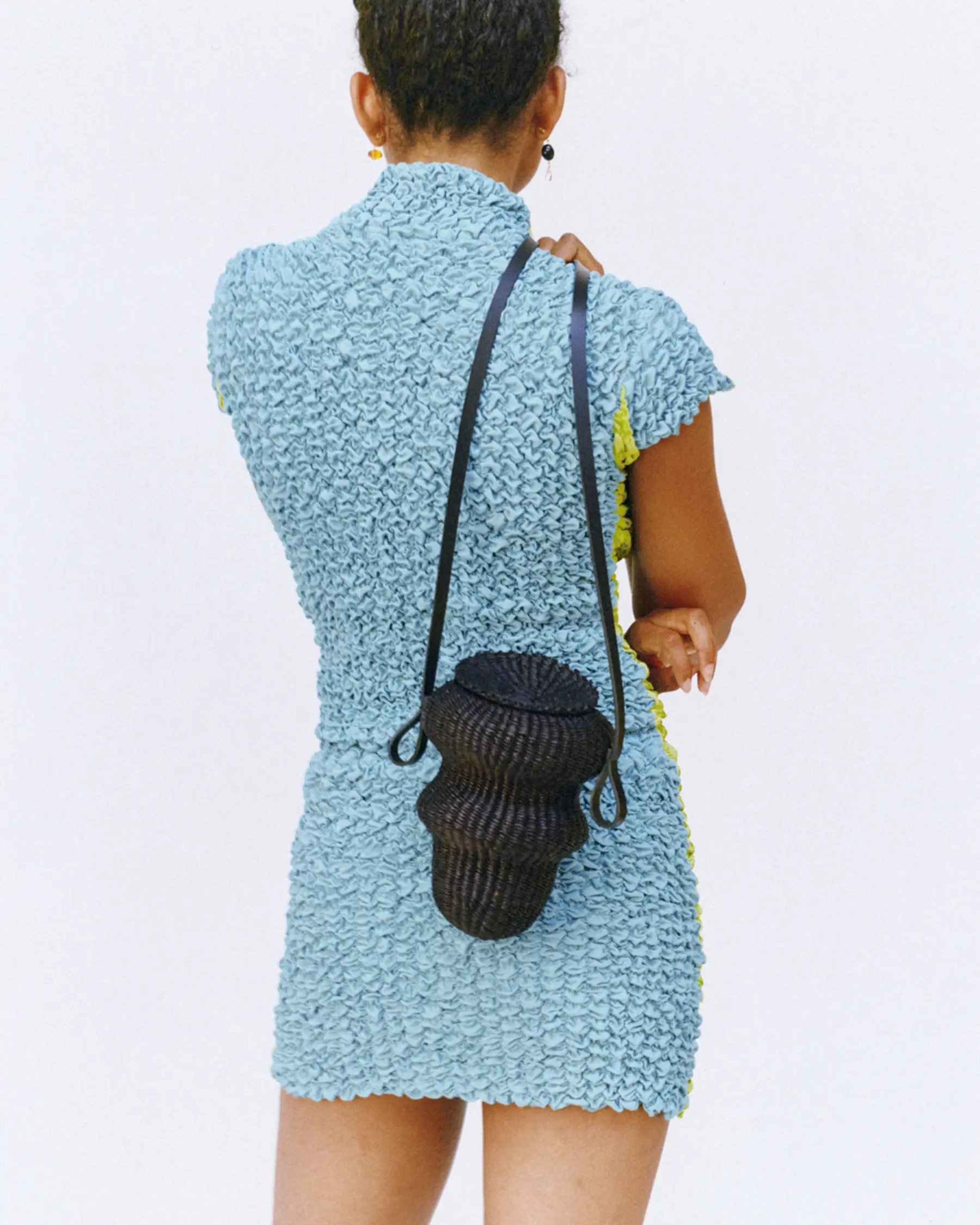


All bags are a matter of envelope. We place our trust in a thin layer of material to carry our belongings — in close relation to our body. We look at the outside, but it’s what lies inside that truly matters.
With basket weavers, the bag’s opening is called the mouth. In the case of the Seau Froissé, the beauty of the shape lies in this frozen movement — as if a scrunched paper bag had been opened and time had stopped halfway through. From a round body, the mouth takes on the shape of a cross. It highlights the balance between inside and outside — the very essence of what this object is made for.


This duality calls on references such as Christo & Jeanne-Claude, whose large-scale installations draw new contours within existing landscapes. The enveloping materials they use shape a portion of space, which becomes something else.
In contrast, Issey Miyake’s pleats define space through the textile itself. The soft fabric doesn’t conform to the body — it generates its own volume, with folds as a structural principle.
In both cases, shape is not decorative but intentional — whether in relation to what it reveals or what it produces.
Can a bag propose space not as a neutral envelope, but as a sculptural object that thinks?
This text is part of an ongoing series of reflections on form, material, and making within the studio’s design research.”